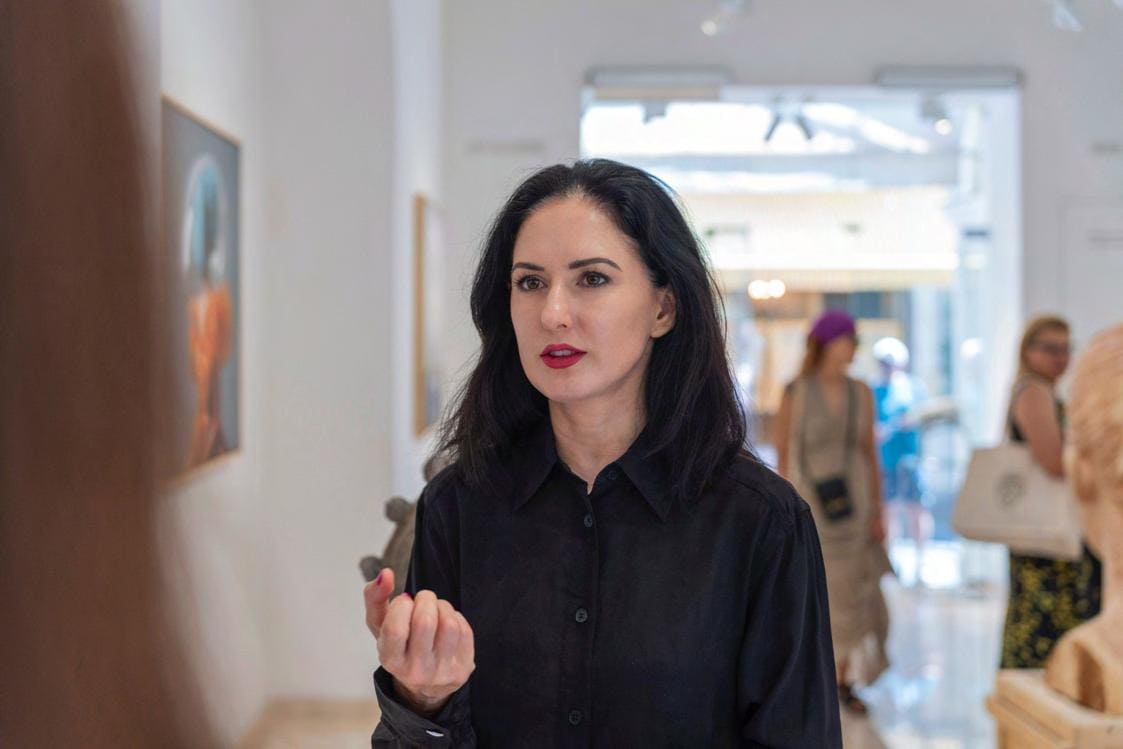
For many different reasons, I am always more excited to talk to a female artist about her art compared to a male artist. My desire to interview Tiffany Trenda started after seeing her work created with AI and her performance ‘Body Code’, which I had the opportunity to see for the first time at the opening of the Liquid Art System gallery in Miami, December 2023. Hosting her exhibition and performance at Liquid Art System gallery Capri and Capri’s iconic square Piazzetta, made this idea come true. On such a small island like Capri but with a capacity to fit worlds inside, we found the perfect spot to realize her performance and interview. I know you will enjoy reading it.
Dr. I. Lir Tan-Senesi: When and how you began to create art? What was your first motivation to create an artistic performance and an artwork?
Tiffany Trenda: I began creating art in my youth, initially drawn to oil painting and fueled by a strong passion for dance. These early explorations allowed me to express my fascination with movement, color, and form. As I entered college, my artistic journey evolved significantly when I started experimenting with video installations and performance art. This period of exploration was pivotal, as it opened up new avenues for me to blend various mediums and rethink traditional boundaries.
The interplay between my early interests in painting and dance naturally led me to investigate how these could be merged with emerging technologies. My curiosity about how technology interacts with the human body inspired me to explore performance art integrated with fashion technology. This approach enabled me to use my body as both a canvas and a medium, combining the tactile and the digital to delve into the dynamic relationship between technology and our physical presence.
In essence, my motivation was to create a dialogue between the corporeal and the digital, to use art as a means to reflect on and critique how technology is reshaping our identities and experiences. This fusion has become the cornerstone of my unique artistic practice, allowing me to continually explore and expand the boundaries of art, performance, and technology.
L.S: What is the story of Body Code art performance? What is its sense and its message?
T.T: “Body Code” is an innovative fusion of fashion, performance, and technology. This work emerged from the observation that QR codes, a new technology at the time, transformed how we interact with and access information. These codes changed our habits, making us more inclined to scan for quick data rather than engage deeply with content. Inspired by this shift, I designed QR codes as a textile, creating a latex suit that could be scanned to reveal different layers of Internet data connected to the body.
The essence of “Body Code” lies in its commentary on our evolving relationship with the Web. As the internet inundates us with data, we have grown accustomed to quickly scanning for information instead of exploring it in-depth. This transformation of the term “scan” from a physical action to a digital interaction underscores how our engagement with screens affects our perception of reality. “Body Code” reflects this by using the act of scanning the suit to symbolize our diminishing connection to the physical body, highlighting a shift toward valuing digital data over our tangible existence.
L.S: What is the story of the intriguing costume you are wearing during your performance which is also your creation? What is its meaning?
T.T: The costume I wear in my performance is a meticulously crafted latex suit embedded with QR codes. The choice of latex was to achieve a more sculptural effect, giving the audience the impression of a robot or statue when I perform. Standing completely still, I embody this illusion, enhancing the visual impact of my work. Each QR code is not merely decorative but a gateway to various layers of information found on the Internet about the body. The suit’s design reflects our contemporary preoccupation with scanning for Web data, transforming the act of viewing into an interactive experience.
The meaning of Body Code is the body’s relationship to the ever-changing Web. For more than a decade, Body Code has been a dynamic and continuously evolving performance piece, adapting to shifts in the Internet. This performance delves into the tension between our physical bodies and this digital existence, inviting the audience to reflect on the evolving relationship between humanity and information in the digital age. Recently, Body Code has incorporated AI, such as ChatGPT, to provoke dialogue about the human body and the impact of artificial intelligence. Through this interaction, I question whether AI can truly provide reliable insights into the body or if it merely echoes flawed data, much like a tape recorder.
L.S: How did you feel about performing on Capri Island? What you can say about your Capri experience?
T.T: Performing on Capri Island was a unique and enriching experience, distinct from any other location I’ve performed in. Each performance brings something new, and this unpredictability is one of the aspects I cherish about my work. Although I’ve performed this piece for over 12 years, each setting offers fresh surprises. In Capri, the audience was not primarily there for the performance, which made my performance an unexpected disruption amid the island’s stunning beauty. This contrast added a layer of intrigue to the experience, as I engaged with an audience that was encountering my art in an entirely unanticipated context.
Lir Senesi: I want to speak about your latest series, “Refractions of Materiality, which are showcased in Liquid Art System Capri now. Your work integrates transparent mediums with paint and artificial intelligence (AI). Can you tell us more about their meaning?
Tiffany Trenda: In my latest series, “Refractions of Materiality,” showcased at Liquid Art System in Capri, I explore the interplay between painting, the human body, and artificial intelligence (AI). Over the past year, I experimented with AI using images from my own performances to examine how AI perceives and represents the body, often revealing only faceless forms. AI notably struggles with recognizing hands and obscured parts of the body, which became a focal point in my exploration.
In “Refractions of Materiality,” I expanded this investigation by integrating reflective surfaces, such as glass, with my self-portrait images to challenge how AI understands both reflections and the human form. The use of glass allowed me to explore the divide between the digital and the material by observing how AI interpreted the distortions and reflections of the body on these surfaces. The physical brushstrokes are intentionally visible over glass objects, creating a tactile contrast that highlights the disparity between the physical act of painting and AI’s digital representation of reflections. This blend of clear mediums with AI’s interpretations deepens the inquiry into how technology reshapes our understanding of the human figure and material presence, provoking viewers to reconsider the relationship between identity, presence, and the evolving digital-material dichotomy.
Lir Senesi: As an artist which is mastering AI, what is your prediction about its future in art?
Tiffany Trenda: As an artist deeply engaged with AI, I foresee its future in art as transformative. AI’s integration will expand artistic horizons, offering new tools to explore creativity and challenge conventional boundaries. It will enhance artistic expression by enabling innovative approaches to representation, pushing the evolution of art towards new forms and deeper insights into human experiences.
L.S: What are your next projects?
T.T: I have several exciting projects in the works, including a brand-new performance that will debut at a Los Angeles institution. I’m also set to debut new work during Miami Art week 2024, which delves deeper into materiality and AI. This time, I’m exploring the interaction between AI and soft materials.
L.S: Anything you want to share with us and your audience?
T.T: I’m thrilled to share that my recent exhibition, ‘Beyond Performance,’ at the Scottsdale Museum of Contemporary Art has just concluded, marking a significant milestone in my artistic journey.
Additionally, I’m honored that my work is in the permanent collections of prestigious institutions including the Beinecke Library at Yale University. Reflecting on past exhibitions in Italy, I premiered ‘Proximity Cinéma’ during the 55th Annual Venice Biennale. Other notable exhibitions include: Art Center Nabi in South Korea, Faena Art Center in Buenos Aires, Laboratorio Arte Alameda in Mexico City, ARS Electronica in Linz, Austria, and Art in Flux at the Barbican in London, UK. These achievements highlight my ongoing commitment to exploring the intersection of technology, performance, and human experience on an international platform.
L.S: It was a pleasure talking to you and discovering your art and creation through your words. Thank you!
T.T: Thank you so much for a wonderful interview and the amazing show in Capri!